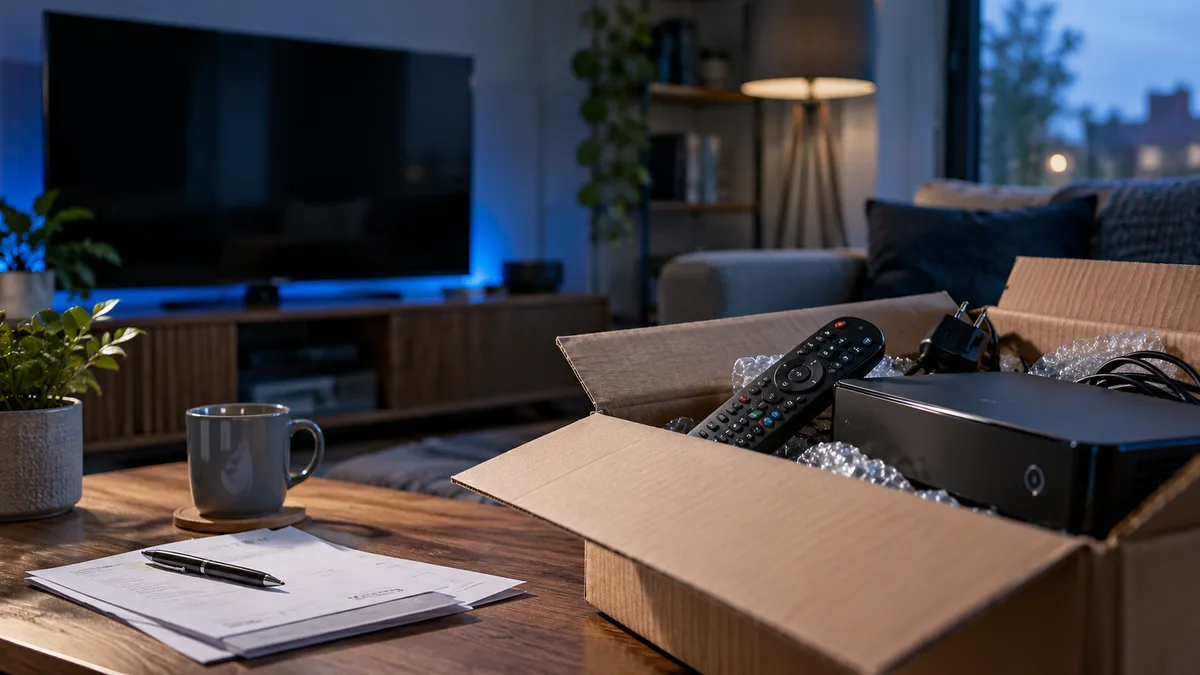

"Cable TV" in the UK usually means Virgin Media's cable network, though many people use it to mean any traditional pay-TV package including satellite. IPTV delivers TV over your broadband to apps on your own devices.
The basics
- Cable/satellite: a dedicated network or dish, a rented box, and a contract.
- IPTV: your broadband, a player app, and a fixed-term plan.
Cost
Traditional packages often start with a base price and add charges for sport, films, HD, 4K and extra rooms, plus annual price rises. IPTV plans tend to include those extras in one price. See our pricing and what affects IPTV cost.
Full comparison
| IPTV | Cable / satellite | |
|---|---|---|
| Contract | Fixed term, no auto-renewal | 18–24 months typical |
| Installation | None | Engineer or dish |
| Extra rooms | Included up to plan limit | Monthly fee per box |
| 4K | Usually included | Often extra |
| Watch away from home | Yes | Limited apps |
| Depends on broadband | Yes | No (for cable/satellite TV) |
| Recording | App-dependent | Built into box |
Picture quality and channels
Both can deliver excellent HD and 4K. IPTV quality depends more on your home network; cable and satellite are less affected by Wi-Fi. IPTV line-ups often include more international channels.
Flexibility: the biggest difference
IPTV works in any room, on any device and when you travel, and you're not locked into a long contract.
Which should you choose?
- Choose IPTV if you have reliable broadband, want flexibility and multiple screens, and dislike long contracts.
- Stick with cable/satellite if your broadband is weak or you rely heavily on built-in box recording.
Leaving Sky? See how to cancel Sky TV.
Is IPTV legal in the UK?
The technology is legal; what matters is whether content is licensed. See Is IPTV legal in the UK?
Final thoughts
Try IPTV alongside your current service before switching. Start a free 24-hour trial.